

Production Process of Galvanized Wire
2025-03-13
Production Process of Galvanized Iron Wire:
1. Material Selection:
High-quality low-carbon steel is selected as the raw material.
2. Wire Drawing:
The steel is drawn through a wire drawing machine to form the wire and achieve the desired diameter.
3. High-Temperature Annealing:
The drawn wire undergoes high-temperature annealing treatment to enhance its ductility and toughness.
4. Pickling:
The annealed wire is immersed in a pickling tank to remove surface oxides, rust, and impurities, ensuring a clean and bright surface.
5. Galvanizing:
Zinc coating is applied to the wire’s surface via hot-dip galvanizing or electroplating.
Hot-dip galvanizing: The wire is heated and passed through a molten zinc bath, triggering a reaction that forms a zinc layer.
Electroplating: The wire acts as a cathode and zinc as an anode, with electric current depositing zinc onto the wire’s surface.
6. Spooling:
The galvanized wire is spooled into coils for easier handling and storage.
7. Cutting and Packaging:
The coiled wire is cut to specified lengths, packaged, and prepared for market distribution.
Will Galvanized Iron Wire Rust?
Fence Wire Mesh in Texas: A Vital Element in the Lone Star State
Related Article

15.5-gauge barbed wire is a mid-range thickness barbed wire primarily used for agricultural and perimeter fencing where a good balance of strength, durability, and cost is needed.
What is 15.5 gauge barbed wire used for?
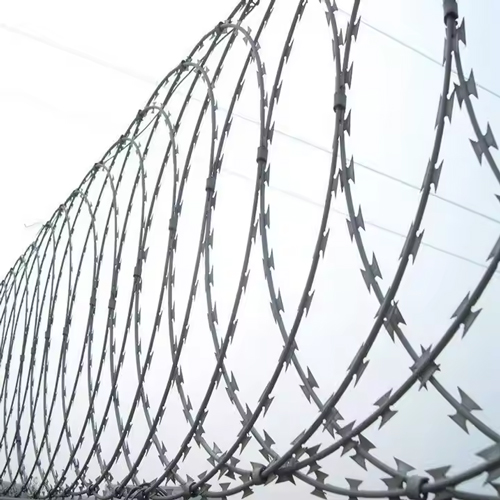
Concertina Wire: A New-Type Protection Mesh Combining Beauty, Practicality, and Strong Anti-Intrusion Performance
Concertina Wire: A Solid Barrier for Modern Security Protection

Stainless steel wire mesh comes in various weaving methods, with plain weave and twill weave being the most common. These two types exhibit distinct differences in wear resistance during use:
What Are the Differences in Wear Resistance Between Plain Weave and Twill Weave Stainless Steel Wire Mesh?